
This feature is on by default. You can turn it off under Members → Settings → Roles and Capabilities → Multiple User Roles (“Allow users to be assigned more than a single role”). When it’s off, WordPress’ normal single-role dropdown comes back.
You can assign a user more than one role by going to that edit user screen in the admin and locating the “Roles” section. There will be a checkbox for every role.
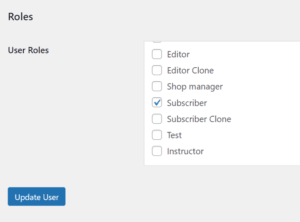
You can also assign multiple roles to a user from the add new user screen (on single sites; on multisite, use the edit user screen).
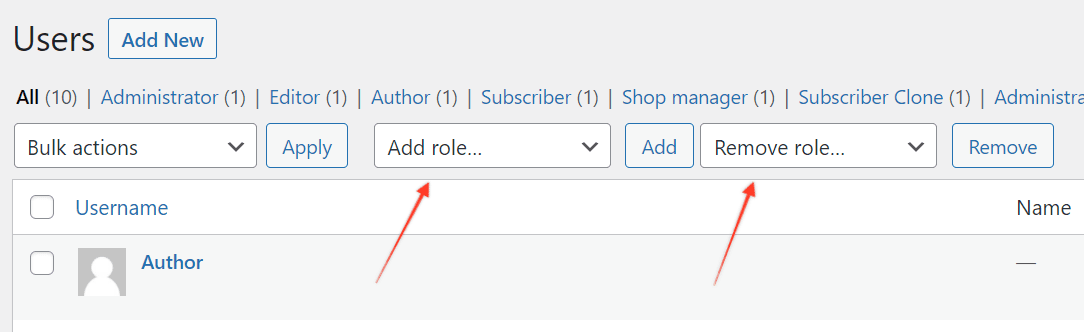
On the “Users” screen in the admin, you can bulk add or remove single roles from multiple users.
How capabilities combine
A user with several roles gets every capability any of their roles grants. If one role grants a capability and another denies it, turn on Denied capabilities should always overrule granted capabilities in Members → Settings so the result is predictable. See Explicitly Deny Capabilities.
Removing every role (“No role for this site”)
The checkboxes replace WordPress’ role dropdown, so you won’t see its “No role for this site” option. To get the same result, untick every role and click Update User. The user account stays, but it has no role, and so no capabilities, on the site.
Troubleshooting
The checkboxes don’t show a checkmark when ticked. Another plugin’s admin styles are hiding the checkmark. The boxes still work: the roles you tick are saved when you click Update User. Members 3.2.26 and later protects its checkboxes from most of these style conflicts. If it still happens:
- Update the other plugin. Older versions of User Registration & Membership (by WPEverest) caused this.
- Use the bulk Add role / Remove role tools on the Users screen instead.
Another “multiple roles” feature is also turned on. Some plugins and admin toolkits have their own multiple-roles option. Running two at once can break saving roles or adding users, so use only one.
A role isn’t in the list. You only see roles you’re allowed to assign. If you use the Role Hierarchy add-on, roles above your own position (and, depending on its setting, equal to it) are hidden.